
China’s Smart Driving Blue Lights Are Becoming a New Source of Light Pollution
How a Safety Feature Designed to Signal ADAS Activation Evolved into a Controversial Symbol of China’s Autonomous Driving Race

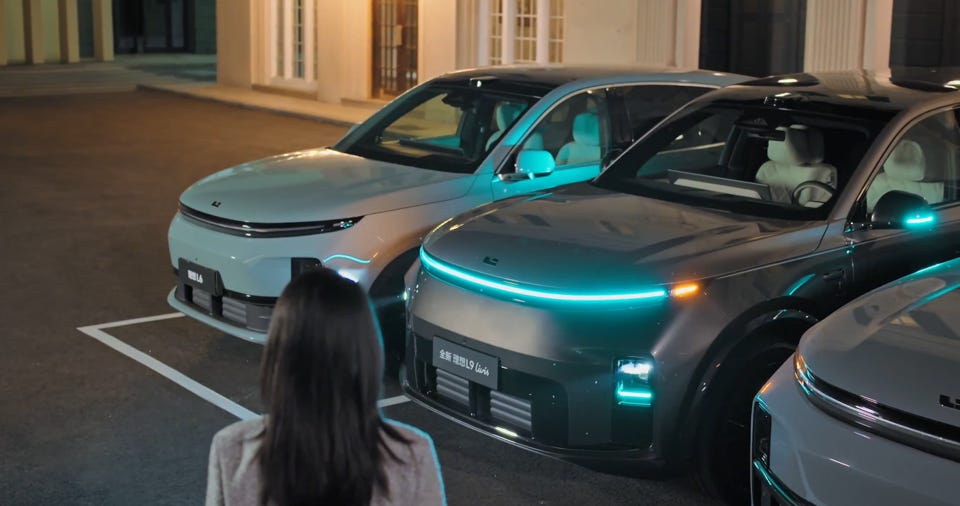
China’s advanced driver assistance systems (ADAS) have created a unique automotive feature rarely seen elsewhere in the world: the Smart Driving Blue Light.
Originally introduced as a visual indicator that a vehicle’s smart driving functions were active, the blue light has rapidly spread across China’s new energy vehicle (NEV) market. Today, it can be found not only on Chinese brands such as Li Auto, XPENG, NIO, and AITO, but increasingly on foreign automakers operating in China, including Toyota.
However, what began as a safety-oriented communication tool is now attracting growing criticism. Chinese social media users and automotive commentators increasingly describe some of these lights as “too bright,” “distracting,” and even “moving light pollution.” As adoption accelerates, calls for national regulation are also growing.
The debate highlights a broader question: How should humans and AI communicate with each other in physical-world transportation systems?
A Unique Chinese Innovation
The Smart Driving Blue Light traces its origins to Li Auto.
Around four years ago, Li Auto introduced an external blue indicator light designed to show when the vehicle’s advanced driver assistance functions were actively controlling part of the driving task.
The concept was simple but powerful.
As ADAS systems become more capable, surrounding drivers, cyclists, and pedestrians often cannot determine whether a vehicle is being driven entirely by a human, partially assisted by software, or operating under a higher level of automated control.
The blue light was designed to make that invisible state visible.
In effect, it communicated:
“This vehicle’s smart driving system is currently active.”
Rather than being a styling element, it was originally conceived as a new form of communication between humans and AI operating in the same traffic environment.
One of the First Physical AI Interfaces
The Smart Driving Blue Light may represent one of the world’s earliest examples of a dedicated interface for what is increasingly being called Physical AI.
Unlike digital AI systems such as ChatGPT, which communicate through screens, text, or voice, physical AI systems interact directly with the real world.
A vehicle operating with ADAS is a physical AI system. It perceives, plans, and executes actions in the physical environment.
This creates a new challenge:
How do surrounding humans know when AI is participating in the driving process?
The blue light emerged as one answer.
It functions as an external status indicator, translating an invisible software state into a visible signal that can be understood by other road users.
Viewed from this perspective, the Smart Driving Blue Light is more than an LED. It is a social interface between humans and AI operating in physical space.
Rapid Industry Adoption
Li Auto’s idea quickly spread throughout China’s automotive industry.
Manufacturers including XPENG, NIO, AITO, and many others adopted similar blue-light systems. More recently, the feature has appeared on some internal combustion engine vehicles and joint-venture brands as well.
According to industry statistics, more than 755,000 vehicles equipped with Smart Driving Blue Lights were delivered in China during the first half of 2025 alone, representing explosive growth.
What was once a niche feature has become one of the most visible symbols of China’s smart driving industry.
From Safety Signal to Marketing Tool
The problem is not the existence of the blue light itself.
The problem is what it has become.
As competition in smart driving technology intensified, some manufacturers began using blue lights as branding tools rather than simple status indicators.
The result was predictable:
Larger light strips
Higher brightness
More aggressive visual designs
Increased emphasis on visibility
Some vehicles now feature blue lights that are significantly brighter than originally intended.
Drivers have reported that certain systems remain distracting not only at night and during rainy weather, but even during daytime operation.
Common complaints on Chinese social media include:
“Brighter than reverse lights.”
“Painful to look at while driving.”
“A moving source of light pollution.”
Poor Placement Is Making the Situation Worse
Brightness is only part of the issue.
Placement has become another major concern.
Some blue lights are installed at nearly the same height as the eye level of drivers in following vehicles. This can create persistent visual discomfort during extended driving.
Other designs integrate the blue light into exterior mirrors, creating situations where even the vehicle’s own driver can see the light source directly.
Critics argue that a feature originally intended to improve safety should not create new distractions for both the vehicle owner and surrounding road users.
No National Standard Exists
A key reason for the current situation is the lack of regulation.
China currently has no unified national standard governing:
Installation position
Brightness levels
Illuminated surface area
Color specifications
Lighting behavior
As a result, implementations vary significantly between manufacturers.
Ironically, a feature introduced to improve awareness and safety is now creating new safety concerns.
This pattern is familiar in China’s EV industry.
Features such as hidden door handles, one-pedal driving, yoke-style steering wheels, and screen-based gear selectors often experienced rapid adoption before their safety implications became the subject of public debate and regulatory review.
The Smart Driving Blue Light appears to be entering the same phase.
Some Automakers Are Already Adapting
Not all manufacturers have ignored the issue.
XPENG’s G7, for example, reportedly incorporates automatic brightness adjustment that adapts to ambient lighting conditions.
Other manufacturers have begun experimenting with:
Indirect lighting
Diffused illumination
Softer light signatures
These approaches demonstrate that technical solutions already exist.
The challenge is not technological capability. It is standardization.
Why Regulation May Be Necessary
The difficulty with relying solely on voluntary industry action is that the negative effects are experienced primarily by people outside the vehicle.
Manufacturers benefit when their smart driving systems are highly visible.
The burden, however, falls on other road users.
This imbalance is similar to many previous automotive safety issues that eventually required regulation.
A national standard covering brightness, placement, and illuminated area would likely preserve the original purpose of the blue light while preventing excessive implementations from becoming visual hazards.
The Goal Is Not to Eliminate the Blue Light
The debate should not be framed as a choice between keeping or banning the blue light.
The underlying concept remains valuable.
As ADAS and smart driving systems become more common, society may increasingly need mechanisms that allow AI-operated systems to communicate their status to nearby humans.
The Smart Driving Blue Light was one of the first attempts to solve that problem.
Its significance extends beyond China.
It offers an early glimpse into how humans and physical AI systems may coexist in shared public environments.
The challenge now is ensuring that this interface remains a useful communication tool rather than evolving into a marketing device or visual distraction.
China’s Smart Driving Blue Light began as a practical solution to a new human-AI interaction problem. The next stage of its evolution will likely depend on whether regulators can preserve its original purpose while ensuring safety, consistency, and public acceptance.